

Examining the conditions for anti-Asian hate in the U.S.
Project tags
Data Storytelling
Non-Profit
Social justice
Scrollytelling
Map
Core TEAM
Me: Design Lead
Lesley Huang: Development Lead
Sam Vickars: Design Support
tools
Overview
A grant project powered by The Asian American Foundation (TAAF) and The Robert Wood Johnson Foundation (RWJF), Roots of Racism aims to draw attention to the epidemic of hate directed at the AAPI community during the COVID-19 pandemic and the fallout that followed thereafter. There was a mismatch between the gravity of the reports of hate crimes reported by the FBI and those of the news media and we wanted to bring that disparity to light.
We used data storytelling and compelling and evocative design to craft an award-winning website and social media assets to bring attention to this ongoing societal crisis.
Our client’s goal is to shape the narrative and bring awareness to this issue using eye-catching data insights and provide actionable steps toward change within TAAF’s broader organizational initiatives.
Process
I started by taking TAAF’s core brand typography and expanding on the look and feel based on what feelings we wanted to evoke in the audience. We chose a dark and gritty aesthetic offset by high contrast color to allow the data to speak for itself.

For client consideration, I laid out two approaches. First was a light, modern and minimal aesthetic, and alternatively, a dark and high contrast aesthetic. The darker moodboard won out, and embodied the message the client wanted to convey. I also pulled inspiration for data viz chart types and styling.
Next was the data. I was tasked with deciding which visualizations were most appropriate for each section to build the narrative in a way that was compelling for readers. The client wanted to ensure the gravity of the situation was conveyed accurately and effectively.

In Figjam, I hand drew the storyboard for the narrative piece by piece, mapping out the flow of information and selecting charts that would be appropriate for each section. This was an important first step before designing the full experience.
Some steps to achieving that balance include:
Chart Selection
Insuring that each visualization fit in each story point, starting with a map to ground readers in the regional outliers in the data over time and relevant news and media influences.
Data Clarity
Pulling out clear comparison points to highlight the differences we wanted readers to pay attention to.
Data Balance
Balancing qualitative and quantitative data in harmony, by way of bar and line charts complimented by quotes and incident reports.


Challenges
There were some data discrepancies, as can be expected. There were a few changes made to the data as we were designing for accuracy and clarity of the findings. We had to make sure we weren’t inflating or deflating the numbers while balancing the goals of the narrative.
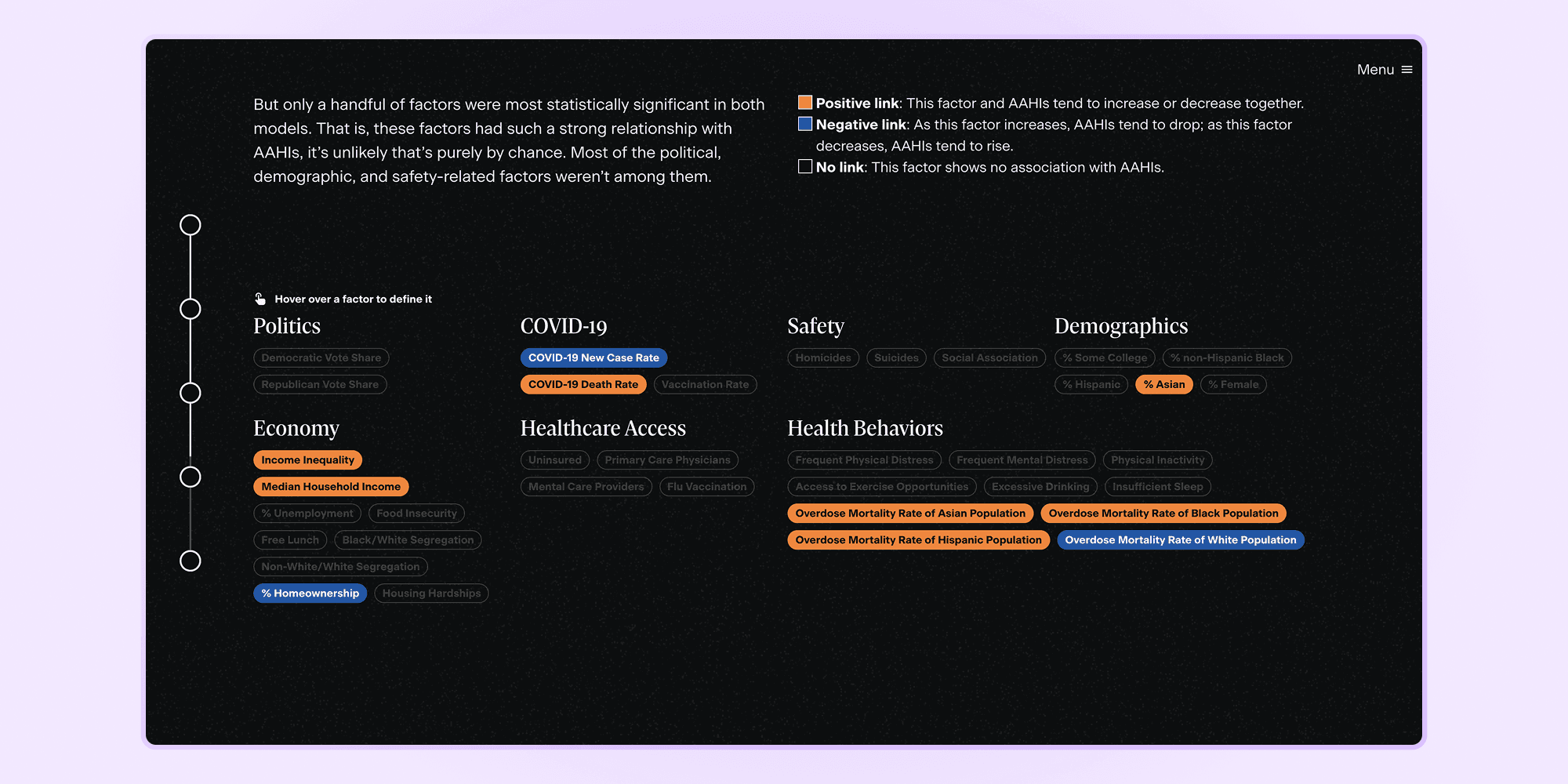
One of the biggest challenges stemmed from the word cloud. The initial data highlighted different positive and negative links to the increase in attacks on AAPI communities. We also had to determine which factors had no link to make sure we were accurately representing cause and effect.
We opted to use the scrollytelling format for this data which allowed us to walk through all the different key takeaways without running the risk of information and data dumping. Breaking up the data into smaller and easier to digest chunks builds momentum and helps to engage the reader throughout the experience. It was also important to keep the copy brief and succinct which sometimes proved to be difficult.
Results
TAAF successfully launched this campaign in August of 2024. It was shortlisted as a winner in the Information is Beautiful Awards that year. This project sits with a myriad of other projects I have worked on and contributed to for TAAF over the course of five years that have led to enhanced awareness around issues that impact the AAPI community in the United States leading to local and nationwide community change.


Want to work together?
I’m looking for my next opportunity. Currently open to hybrid or remote full-time and contract roles.

© 2026 Aria Todd | Made with Framer
Examining the conditions for anti-Asian hate in the U.S.
Project tags
Data Storytelling
Non-Profit
Social justice
Scrollytelling
Map
Core TEAM
Me: Design Lead
Lesley Huang: Development Lead
Sam Vickars: Design Support
tools
Overview
A grant project powered by The Asian American Foundation (TAAF) and The Robert Wood Johnson Foundation (RWJF), Roots of Racism aims to draw attention to the epidemic of hate directed at the AAPI community during the COVID-19 pandemic and the fallout that followed thereafter. There was a mismatch between the gravity of the reports of hate crimes reported by the FBI and those of the news media and we wanted to bring that disparity to light.
We used data storytelling and compelling and evocative design to craft an award-winning website and social media assets to bring attention to this ongoing societal crisis.
Our client’s goal is to shape the narrative and bring awareness to this issue using eye-catching data insights and provide actionable steps toward change within TAAF’s broader organizational initiatives.
Process
I started by taking TAAF’s core brand typography and expanding on the look and feel based on what feelings we wanted to evoke in the audience. We chose a dark and gritty aesthetic offset by high contrast color to allow the data to speak for itself.
For client consideration, I laid out two approaches. First was a light, modern and minimal aesthetic, and alternatively, a dark and high contrast aesthetic. The darker moodboard won out, and embodied the message the client wanted to convey. I also pulled inspiration for data viz chart types and styling.
Next was the data. I was tasked with deciding which visualizations were most appropriate for each section to build the narrative in a way that was compelling for readers. The client wanted to ensure the gravity of the situation was conveyed accurately and effectively.
In Figjam, I hand drew the storyboard for the narrative piece by piece, mapping out the flow of information and selecting charts that would be appropriate for each section. This was an important first step before designing the full experience.
Some steps to achieving that balance include:
Chart Selection
Insuring that each visualization fit in each story point, starting with a map to ground readers in the regional outliers in the data over time and relevant news and media influences.
Data Clarity
Pulling out clear comparison points to highlight the differences we wanted readers to pay attention to.
Data Balance
Balancing qualitative and quantitative data in harmony, by way of bar and line charts complimented by quotes and incident reports.
Challenges
There were some data discrepancies, as can be expected. There were a few changes made to the data as we were designing for accuracy and clarity of the findings. We had to make sure we weren’t inflating or deflating the numbers while balancing the goals of the narrative.
One of the biggest challenges stemmed from the word cloud. The initial data highlighted different positive and negative links to the increase in attacks on AAPI communities. We also had to determine which factors had no link to make sure we were accurately representing cause and effect.
We opted to use the scrollytelling format for this data which allowed us to walk through all the different key takeaways without running the risk of information and data dumping. Breaking up the data into smaller and easier to digest chunks builds momentum and helps to engage the reader throughout the experience. It was also important to keep the copy brief and succinct which sometimes proved to be difficult.
Results
TAAF successfully launched this campaign in August of 2024. It was shortlisted as a winner in the Information is Beautiful Awards that year. This project sits with a myriad of other projects I have worked on and contributed to for TAAF over the course of five years that have led to enhanced awareness around issues that impact the AAPI community in the United States leading to local and nationwide community change.
Want to work together?
I’m looking for my next opportunity. Currently open to hybrid or remote full-time and contract roles.
© 2026 Aria Todd | Made with Framer
Examining the conditions for anti-Asian hate in the U.S.
Project tags
Data Storytelling
Non-Profit
Social justice
Scrollytelling
Map
Core TEAM
Me: Design Lead
Lesley Huang: Development Lead
Sam Vickars: Design Support
tools
Overview
A grant project powered by The Asian American Foundation (TAAF) and The Robert Wood Johnson Foundation (RWJF), Roots of Racism aims to draw attention to the epidemic of hate directed at the AAPI community during the COVID-19 pandemic and the fallout that followed thereafter. There was a mismatch between the gravity of the reports of hate crimes reported by the FBI and those of the news media and we wanted to bring that disparity to light.
We used data storytelling and compelling and evocative design to craft an award-winning website and social media assets to bring attention to this ongoing societal crisis.
Our client’s goal is to shape the narrative and bring awareness to this issue using eye-catching data insights and provide actionable steps toward change within TAAF’s broader organizational initiatives.
Process
I started by taking TAAF’s core brand typography and expanding on the look and feel based on what feelings we wanted to evoke in the audience. We chose a dark and gritty aesthetic offset by high contrast color to allow the data to speak for itself.
For client consideration, I laid out two approaches. First was a light, modern and minimal aesthetic, and alternatively, a dark and high contrast aesthetic. The darker moodboard won out, and embodied the message the client wanted to convey. I also pulled inspiration for data viz chart types and styling.
Next was the data. I was tasked with deciding which visualizations were most appropriate for each section to build the narrative in a way that was compelling for readers. The client wanted to ensure the gravity of the situation was conveyed accurately and effectively.
In Figjam, I hand drew the storyboard for the narrative piece by piece, mapping out the flow of information and selecting charts that would be appropriate for each section. This was an important first step before designing the full experience.
Some steps to achieving that balance include:
Chart Selection
Insuring that each visualization fit in each story point, starting with a map to ground readers in the regional outliers in the data over time and relevant news and media influences.
Data Clarity
Pulling out clear comparison points to highlight the differences we wanted readers to pay attention to.
Data Balance
Balancing qualitative and quantitative data in harmony, by way of bar and line charts complimented by quotes and incident reports.
Challenges
There were some data discrepancies, as can be expected. There were a few changes made to the data as we were designing for accuracy and clarity of the findings. We had to make sure we weren’t inflating or deflating the numbers while balancing the goals of the narrative.
One of the biggest challenges stemmed from the word cloud. The initial data highlighted different positive and negative links to the increase in attacks on AAPI communities. We also had to determine which factors had no link to make sure we were accurately representing cause and effect.
We opted to use the scrollytelling format for this data which allowed us to walk through all the different key takeaways without running the risk of information and data dumping. Breaking up the data into smaller and easier to digest chunks builds momentum and helps to engage the reader throughout the experience. It was also important to keep the copy brief and succinct which sometimes proved to be difficult.
Results
TAAF successfully launched this campaign in August of 2024. It was shortlisted as a winner in the Information is Beautiful Awards that year. This project sits with a myriad of other projects I have worked on and contributed to for TAAF over the course of five years that have led to enhanced awareness around issues that impact the AAPI community in the United States leading to local and nationwide community change.
Want to work together?
I’m looking for my next opportunity. Currently open to hybrid or remote full-time and contract roles.
© 2026 Aria Todd | Made with Framer